USA TRAVEL GUIDE
Atlanta Skyline Photography from Jackson Street Bridge
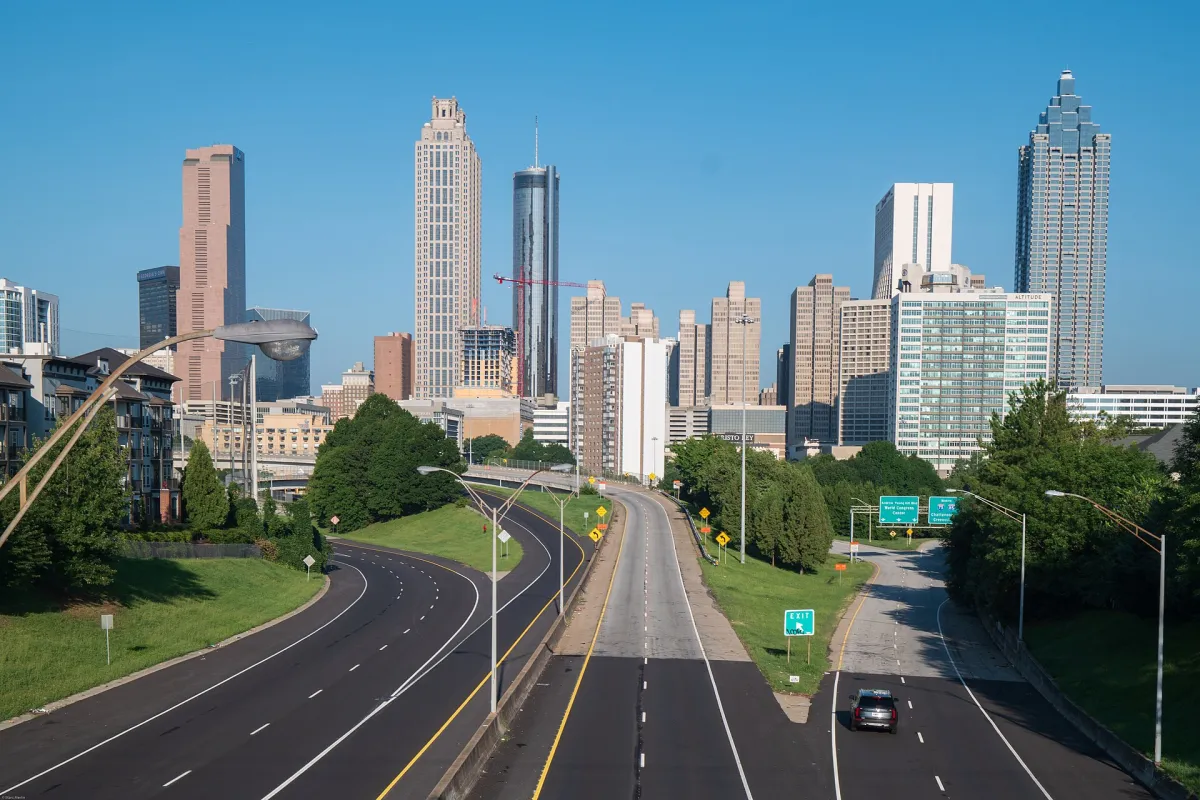
The view from Jackson Street Bridge gives Atlanta a clear visual structure: a curving transport corridor draws the eye towards downtown towers, with trees separating road and skyline. This page reads the photograph made on 16 August 2020 and explains how to approach the viewpoint thoughtfully. It is a photography companion to the USA guide, rather than a second general Atlanta itinerary.
Read the road and skyline together
The road is an active part of this composition. Its broad curve creates depth before the eye reaches the buildings, while the foreground greenery keeps the image from becoming a flat inventory of towers. Notice how the skyline occupies the upper part of the frame without filling every corner. The surrounding sky leaves room for the shapes of the buildings to register.
Try two versions when you visit: one that keeps the full road curve and another that reduces the foreground to concentrate on the skyline. Compare the outer edges before taking the photograph. A lamp post or bright vehicle cut awkwardly by the border can draw more attention than the buildings you intended to show. Changing your position slightly is often more useful than adding a digital filter.
The brightest road surface runs up the centre of the reference, while darker lanes curve in from the left and a separate traffic stream appears on the right. That asymmetry is useful: the picture has a direction without requiring the skyline to sit at the exact centre of every line. Notice the large foreground lamp at left. Including it makes the bridge position more apparent, but its curved arm also competes with the towers. Before changing equipment, compare a frame that deliberately keeps this near object with one that excludes it from a lawful standing position.
Choose daylight or an evening skyline
The source photograph records a daylight scene, with detail in the trees, roadway and building faces. A similar approach suits visitors who want a clear geographic introduction to downtown. Late-day light changes the relationship between the sky and the buildings; an evening silhouette will therefore tell a different story from the illustrated daytime view.
Discover Atlanta identifies Jackson Street Bridge as a downtown skyline viewpoint and suggests comparing different times of day. Treat that as a reason to choose your preferred visual result, rather than a promise that every sunset will be colourful. Cloud cover can flatten the scene or create a stronger sky; both can work if you expose for the part of the image that matters.
The clear blue sky and warm-coloured building faces create a straightforward separation of forms. A light grey tower can almost merge with a pale cloud on another day, while a darker tower may remain readable. Judge these relationships on the scene itself. The recorded date and source clock reading are not a current sunrise plan, and the photograph does not establish the correct compass direction for every future visit. For a short stop, decide whether your priority is legible buildings or the mood of the sky; that choice makes the exposure and framing decisions much clearer.
Use the bridge as a shared public place
Plan the photograph from the pedestrian space and keep the travel lanes completely clear. The bridge is not a private platform for a photo session. Leave room for people to pass, hold equipment securely and step away from the rail before reviewing a long sequence of images. Avoid placing bags where someone may trip while looking towards the skyline.
The tourism authority locates the viewpoint on Jackson Street NE between Cain Street and Highland Avenue. Check your walking route and the current street arrangement before setting out. A past photograph cannot confirm today’s roadworks, crossing conditions or available parking. For an organised shoot, check applicable city requirements rather than treating an informal personal visit as permission for a larger setup.
Prepare a small set of decisions before reaching the busiest part of the pedestrian space: whether you want the road curve, a person in the frame or a tighter building arrangement. This reduces the amount of time spent opening bags and testing accessories beside passing people. Review a few images from a position where you are no longer occupying the narrowest route. If you cannot make the preferred composition without leaning into traffic space or forcing others to step around equipment, choose another composition. The visible transport corridor is the subject, not an invitation to enter it.
Make a small series without repeating one frame
An effective set could contain a broad establishing view, a tighter skyline arrangement and a detail of the road’s geometry. These photographs serve different purposes even when made from one stop. Give traffic time to rearrange itself between frames: an otherwise quiet foreground may gain scale from a vehicle, while a large bright bus may dominate a composition you intended to keep simple.
For a portrait, keep the person securely on the pedestrian side and make the skyline a background rather than requiring them to approach the road. If the bridge is busy, shorten the session or return at another permitted time. The best alternative may be a quieter composition elsewhere in the neighbourhood, not a more precarious position at the same rail.
The crane and partly completed structure visible among the towers provide a useful detail about the photograph’s moment in time. In a full establishing view, they belong to that recorded skyline rather than an error to disguise with an inaccurate caption. In a new photograph, an active construction feature can give scale or explain change. If you want a cleaner architectural study, make a deliberately different crop and describe its subject accordingly. Avoid naming an unfinished structure or assigning its present use unless you have a reliable source for that identification.
Understand what the reference can and cannot show
The source date matters because skylines and street layouts evolve. This 2020 photograph is a visual reference for the relationship between bridge, road and downtown, not a complete inventory of Atlanta’s present buildings. The photographer’s original work and licence remain credited below the image. No personal visit, exact camera setting or current tripod approval is inferred from the picture.
Use this stop as a focused photography break within your wider route. If conditions are poor, a readable daytime skyline is usually more useful than waiting beside traffic for an uncertain sunset. Return to the USA Photo Spots guide to compare this urban perspective with coastal, mountain and monument subjects elsewhere in the country.
Choose the final image by the relationship it communicates, rather than selecting only the sharpest individual tower. In a small display, the centre roadway remains a strong shape even when window detail disappears. A tighter skyline picture may work better when the intended use requires recognisable building outlines at a smaller size. Compare both before discarding either. For an album, use the wide frame to introduce Atlanta’s road-and-tower relationship, then follow it with a distinct city detail from elsewhere on your route. That sequence gives this viewpoint a clear job without making several near-identical versions carry the entire story.
Continue planning your USA trip
Sources and further reading
FAQ
Is Jackson Street Bridge a downtown or Midtown view?
The illustrated photograph looks towards downtown Atlanta. Keep that subject description with the image rather than labelling every Atlanta skyline as Midtown.
Does this photograph prove the best time to visit?
No. It records one daylight scene in August 2020. The most useful timing depends on whether you want building detail, a silhouette or evening illumination, as well as current weather.
Do I need to recreate the exact photograph?
No. The source is useful for understanding the viewpoint. Make a different composition from a lawful pedestrian position and avoid imitating any setup that would obstruct the bridge.