
INDONESIA · BALI TRAVEL GUIDE
Tirta Gangga Rice-Field Photography: Framing East Bali’s Countryside
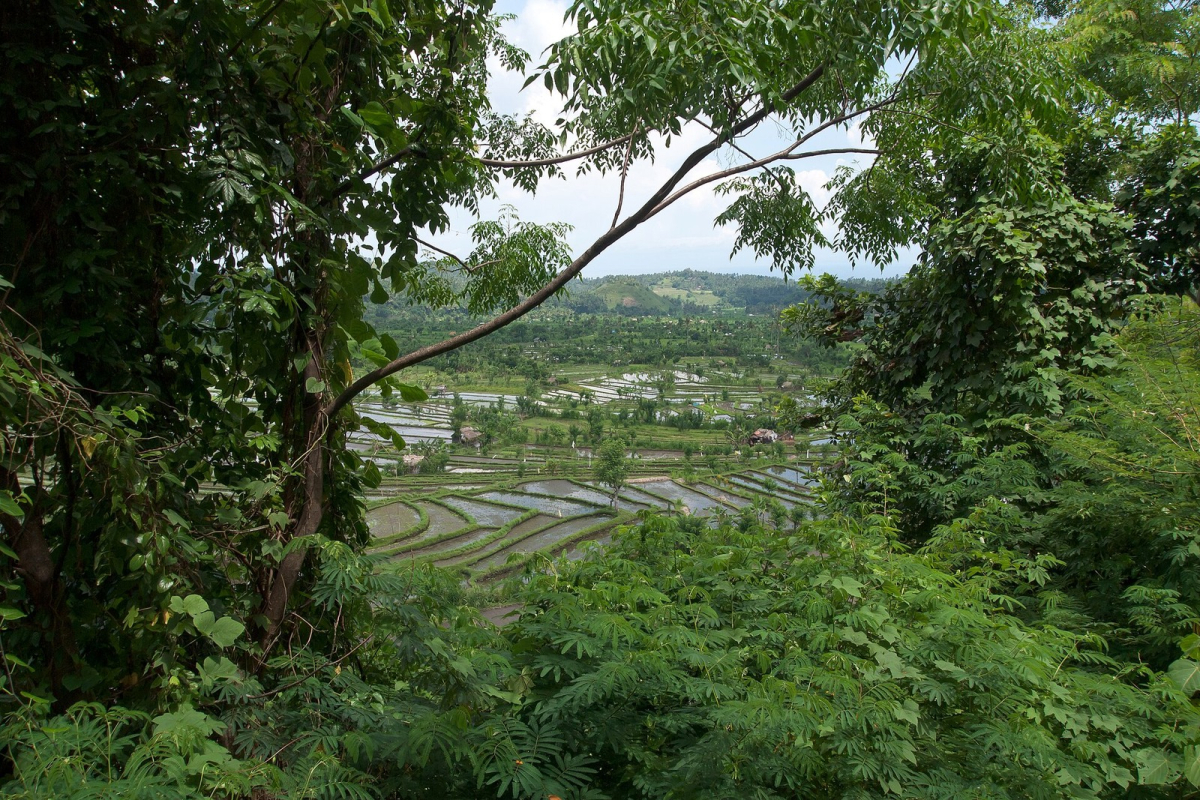

Water-filled rice plots appear through an opening in thick foliage in this east Bali photograph. A curved branch crosses the upper frame, while terraces spread across the valley beyond. The source places the scene in the countryside around Tirta Gangga, along the Amlapura–Amed road, and records it in 2010. It explicitly distinguishes these fields from the water-palace complex itself.
Use foliage as a frame, not a curtain
The near vegetation creates a dark border around the brighter fields. That gives the image depth and directs attention towards the terrace pattern. The opening is important: too much foliage would conceal the subject, while removing it entirely would produce a more conventional open landscape.
When making a similar photograph, check whether a branch crosses an important part of the distant field pattern. Moving sideways can open a clearer gap without changing the overall idea. Look at the corners for bright leaves or tangled stems that draw attention away from the valley. A natural frame works best when it leaves the main subject easy to read.
Read the shapes of the working fields
The boundaries between plots create curved and angular lines across the valley. Water reflects the sky, making some plots brighter than the surrounding vegetation. Those shapes tell us more about the scene than a general description of green countryside would.
Do not infer an exact planting or harvest stage from one distant picture unless that information is documented. The water-filled appearance is visible, but the source does not establish a calendar that another visitor can follow. Rice landscapes change as fields are worked, and neighbouring plots can look different during the same visit.
Treat the fields as working land
A terrace edge is not automatically a public footpath. Ask about access before entering fields, crossing irrigation channels or walking on narrow bunds. Stay clear of workers and machinery, and do not step into planted areas merely to remove a foreground obstruction. A roadside view also needs a lawful, stable place to stop.
These practical limits are part of making the photograph, not separate from it. A clear frame from an approved path can be more useful than an intrusive position in a field. The Responsible Travel guide considers choices that respect the people maintaining the landscape.
Keep the place name and heritage claims precise
Tirta Gangga’s water palace and the surrounding countryside are related geographically but are different photographic subjects. This picture does not show the palace’s stepping stones or ornamental pools. Use the Attractions guide for the palace visit and the Bali map for wider east-coast orientation.
UNESCO’s Bali cultural-landscape description explains the wider relationship between rice cultivation, irrigation and water temples. It does not establish that every rice field on Bali is part of the listed property. No such designation is claimed for the precise fields shown here, and no exact camera coordinates are established by the available source.
Frequently asked questions
Are these fields inside Tirta Gangga water palace?
No. The photograph’s source explicitly identifies the surrounding Tirta Gangga countryside along the Amlapura–Amed road rather than the palace complex.
Are these particular terraces confirmed as a UNESCO World Heritage component?
That designation is not established for the exact fields in this photograph. Bali’s listed cultural landscape should not be used as a label for every terrace on the island.
Can the exact roadside viewpoint be copied?
No exact camera coordinates are established. Arrange a lawful, stable stop and ask before entering any working farmland.