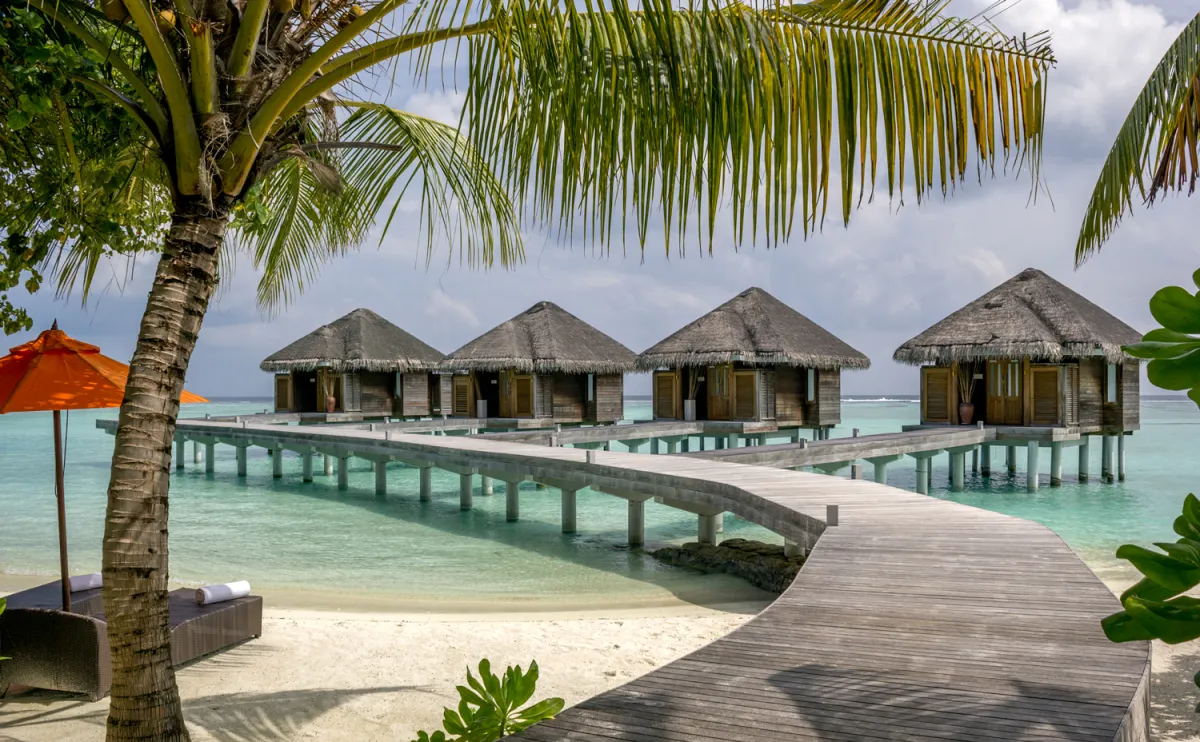
The licensed photograph by Jonathan Palombo was taken in November 2014 and is titled “Lux* Maldives” in its source record. It shows a curving timber walkway, repeated overwater pavilions and palms framing the foreground. The source does not identify the pavilions’ precise function, so they are discussed as architecture rather than assigned a guest-room category. For choosing accommodation, continue to the Maldives resort guide.
Diva Maldives and the current property name
The tourism board’s older listing for LUX South Ari Atoll retains references to Diva Maldives and places the property on Dhidhoofinolhu in South Ari Atoll. The resort’s current official site uses LUX* South Ari Atoll. That makes the former name useful for understanding old albums, links and documents, while the current name is the appropriate starting point for booking enquiries.
Do not assume that an image labelled Diva represents an unchanged room at LUX today. Rebranding can accompany changes, and the official resort now describes refurbished water villas. Match any specific accommodation claim with the current category description. The 2014 photograph here has a clear role: it records an arrangement of walkways, roofs and lagoon at a known time. It is not a room inspection or a promise that a particular building can be booked. Keeping those uses separate makes the historical image more informative rather than less valuable.
Read the curve of the walkway
The walkway enters prominently from the foreground and bends toward the overwater structures. That curve gives the image movement and depth. The eye follows timber boards before reaching a repeated line of roofs, then continues to the sea beyond. A photograph made from a slightly different position could make the curve less clear or allow one pavilion to hide another.
When photographing a similar permitted walkway, first choose where the line enters your frame. A corner entry can create a strong diagonal, while an entry near the centre can make the picture feel more formal. Keep enough of the nearest boards to explain the curve. Avoid letting the walkway become a narrow strip that appears to begin nowhere. Check whether the horizon is level and whether the posts look reasonably upright. These small decisions help the scene read as a place with structure, rather than just another collection of attractive tropical details.
Use palms as a frame without hiding the subject
The palm trunk and overhanging fronds create a foreground around the overwater architecture. They help establish the photographer’s position on land and provide a contrast of texture: rough bark and irregular leaves against straight timber and repeated roof shapes. The frame works because enough of the principal buildings remains visible.
Test a version with fewer fronds and another with a stronger foreground. A leaf touching the tip of a roof can look accidental; a clear gap between them often makes both shapes easier to understand. You do not need to move or cut vegetation to achieve that separation. Change your own position within the permitted space. In wind, make several exposures because a moving frond may briefly cross the main subject. For a phone photograph, check that the device has not focused entirely on the closest leaf while leaving the architecture soft.
Study repetition, timber and roof texture
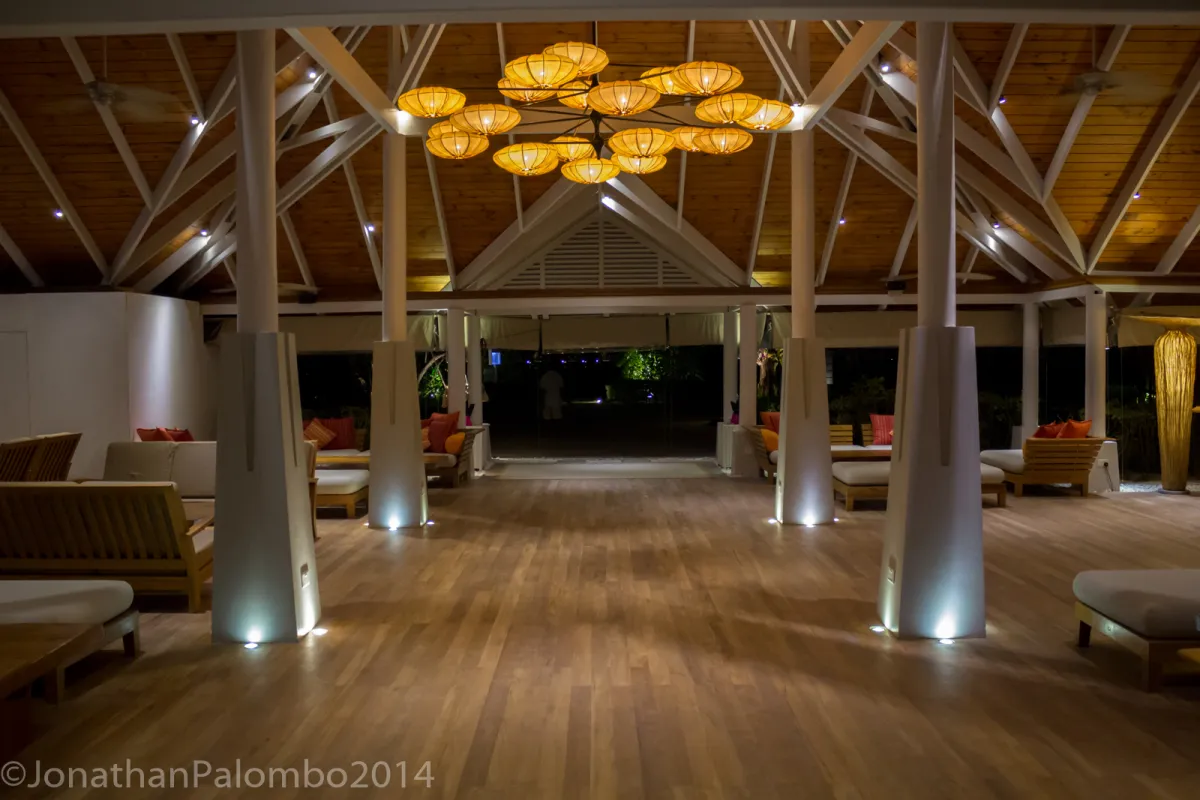
The reception photograph changes the scale of the sequence. Instead of the overwater pavilions in the opening image, it shows an interior at LUX Maldives in 2014: repeated roof beams, a timber floor, seating and a group of warm ceiling lights. The structural lines draw the eye towards the open end of the room. This is the reception named by the source, not an unidentified villa interior.
For an architectural study, choose whether the roof structure, the floor or the lighting should dominate. A central viewpoint can make repetition easy to read, while a slight move to one side may distinguish overlapping beams. Keep the camera level before deciding whether to include more ceiling. Check bright lamps and pale columns so that they retain detail, and avoid lifting the shadows until the room no longer resembles its actual lighting.
Compare the interior with the opening overwater photograph through materials and rhythm rather than assuming the buildings have the same function. Timber and repeated supports connect the two scenes, but the reception does not show posts reflected in the lagoon or a villa’s private deck. Ask before photographing a working reception, avoid identifying other guests without permission, and keep staff routes clear. The historical image is useful for studying design; present layouts and access need current confirmation.
Balance tropical brightness and cloud
The historical scene combines bright sand, shaded palms and a cloudy sky. Each responds differently to exposure. If you brighten the darkest vegetation until every leaf is visible, the sand may lose texture. If you expose solely for the sky, the walkway may become much darker than it appeared in person. Keep a balanced version and, when useful, an alternative exposure with more protected highlights.
Cloud can give wooden structures a gentler light than strong midday sun. The lagoon may appear less saturated, but material details can become easier to see. Avoid treating blue-green water as the only measure of success. In the featured image, the curve, spacing and foreground frame carry much of the interest. During editing, compare pale sand with a neutral reference rather than pushing every warm tone. A restrained colour adjustment can preserve the relationship between the materials and the sea without making a historical photograph look like a newly produced advertising rendering.
Plan a present-day visit using current information
The current resort site identifies the property as LUX* South Ari Atoll on Dhidhoofinolhu and describes access by seaplane. Confirm the transfer arrangements, flight details and total cost for your own booking. An image of water villas does not tell you which transport is included, whether an arrival time works or which areas are open to a visitor from another island.
If a particular photographic viewpoint matters, ask the property whether the setting is still accessible and whether it lies in a guest-only or restricted area. Include the photograph when asking, while acknowledging its historical date. That is more useful than requesting access to an unverified building name. Plan your first and last days around transfers, leaving detailed photography for the time actually available. The airport and transfer guide explains why a short flight description should not be read as the complete door-to-door journey.
Create an accurate record rather than a room promise
For a small album, pair an overall architectural view with a closer material detail and a scene that explains the island’s relationship with the water. Make each photograph contribute something different. An empty walkway can show design well, but it does not mean that the area stays empty throughout the day. Nor does an attractive lagoon establish safe swimming conditions or a wildlife encounter.
When sharing older pictures, include the current property name, the capture date and the former name only where it helps readers identify the place. Preserve the original photographer and licence for reused images. Do not silently transfer the credit of an old unverified file to a newly acquired photograph. Those are separate works with separate histories. A carefully identified historical view can support the wider Maldives photography guide without duplicating hotel descriptions or overstating what the photograph can prove.
Frequently asked questions
Is Diva Maldives the same property as LUX South Ari Atoll?
The older tourism-board listing links the Diva name with the property now known as LUX* South Ari Atoll on Dhidhoofinolhu. Use the current name when making enquiries, while retaining the former name when explaining historical records.
Does the featured photograph show a particular room category?
The source identifies LUX Maldives but does not identify the function of the visible pavilions. The image is therefore described as overwater architecture, without assigning a villa or spa category.
Are the 2014 buildings and interiors unchanged?
That cannot be concluded from the photograph. The current property describes refurbished accommodation; check current plans, images and booking details for the exact category you want.