
Sign in
For Photos4Travel editors and team members.
Hawaii · Outrigger Canoe Photography
Outrigger Canoe Photography in Hawaii: Craft, Context and Permission
An outrigger canoe can make a compelling shoreline subject, but it is also a working craft belonging to someone. Photograph its relationship with the coast without moving it, boarding it or interrupting the people using it. A thoughtful image can show the form of the craft and acknowledge that it has a purpose beyond a visitor’s composition.
On this page · 4 sections ShowHide

Show how the craft sits in its setting
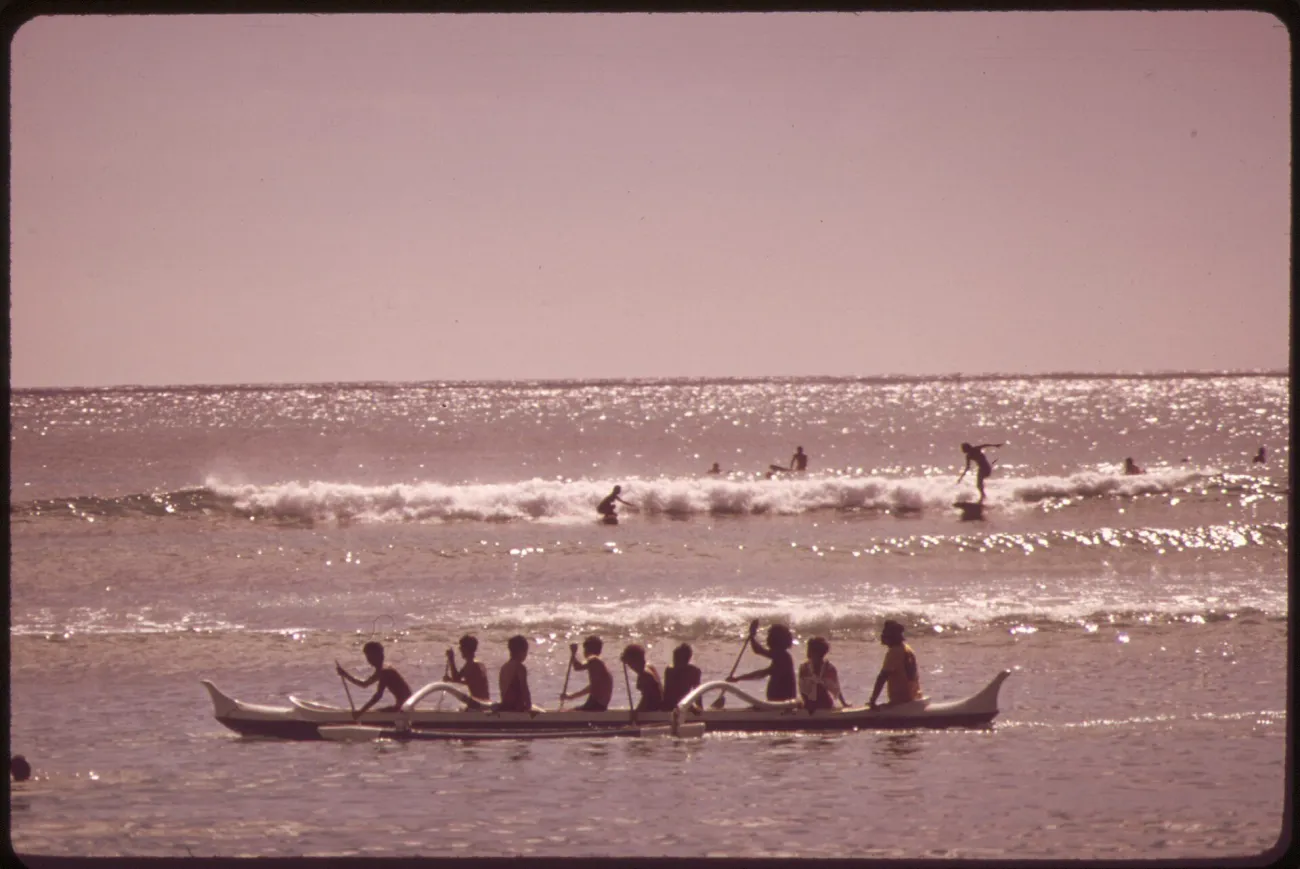
Charles O’Rear’s historical NARA photograph, dated 1973 in its record, places a canoe and paddlers in dark outline against bright Waikīkī water, with surfers farther behind. The long horizontal craft and repeated paddles give the foreground rhythm. Its archival colour and source context belong to the image; it does not show the boats, operators or conditions available today.
Choose whether the picture is about the canoe’s shape or its place along the shore. A wider frame can relate craft, water and landscape. A closer one can emphasise a construction detail when public access and permission allow. Keep the actual visible form in the description; do not infer material, maker or age from appearance alone.
Look for overlapping elements that make the craft difficult to read. A modest change of position along the permitted route may clarify it. The solution is to move your camera position, not someone else’s equipment. Leave paddles, supports and stored items exactly as they are.
Paddling and voyaging have different contexts
Do not use every canoe photograph as an illustration of the same tradition. Recreational paddling, racing, a visitor lesson and long-distance voyaging can involve different craft and activities. Identify the particular subject only as far as the source establishes it. A canoe pictured on shore does not prove that a named lesson or club was operating there.
For a broader introduction to voyaging, use the Polynesian Voyaging Society’s material. Its account of navigation and observation provides context without turning an unidentified outrigger into a particular voyaging canoe. Our culture guide explains how to choose a learning experience.
Ask before photographing people or joining an activity
If paddlers are preparing, carrying or launching a craft, leave the route clear and follow their instructions. Ask before a close portrait or photographing a small private session. A friendly exchange does not automatically authorise boarding, touching equipment or recording a conversation.
When booking an outing, check the actual operator, meeting place, participant requirements, included equipment and weather policy. A historical photograph is not proof of today’s service. Consider whether you want to take part or to photograph from land; trying to do both can distract from instructions at important moments.
Protect camera equipment from water and keep it out of the way during boarding. If the provider cannot accommodate a camera safely, accept that limit. A small set of shore photographs can preserve the memory without interrupting the activity itself.
Frequently asked question
May I sit in a canoe on the beach for a photograph?
Only with the owner’s clear permission. Do not treat a stored craft as a public prop; leave equipment and launch access undisturbed.