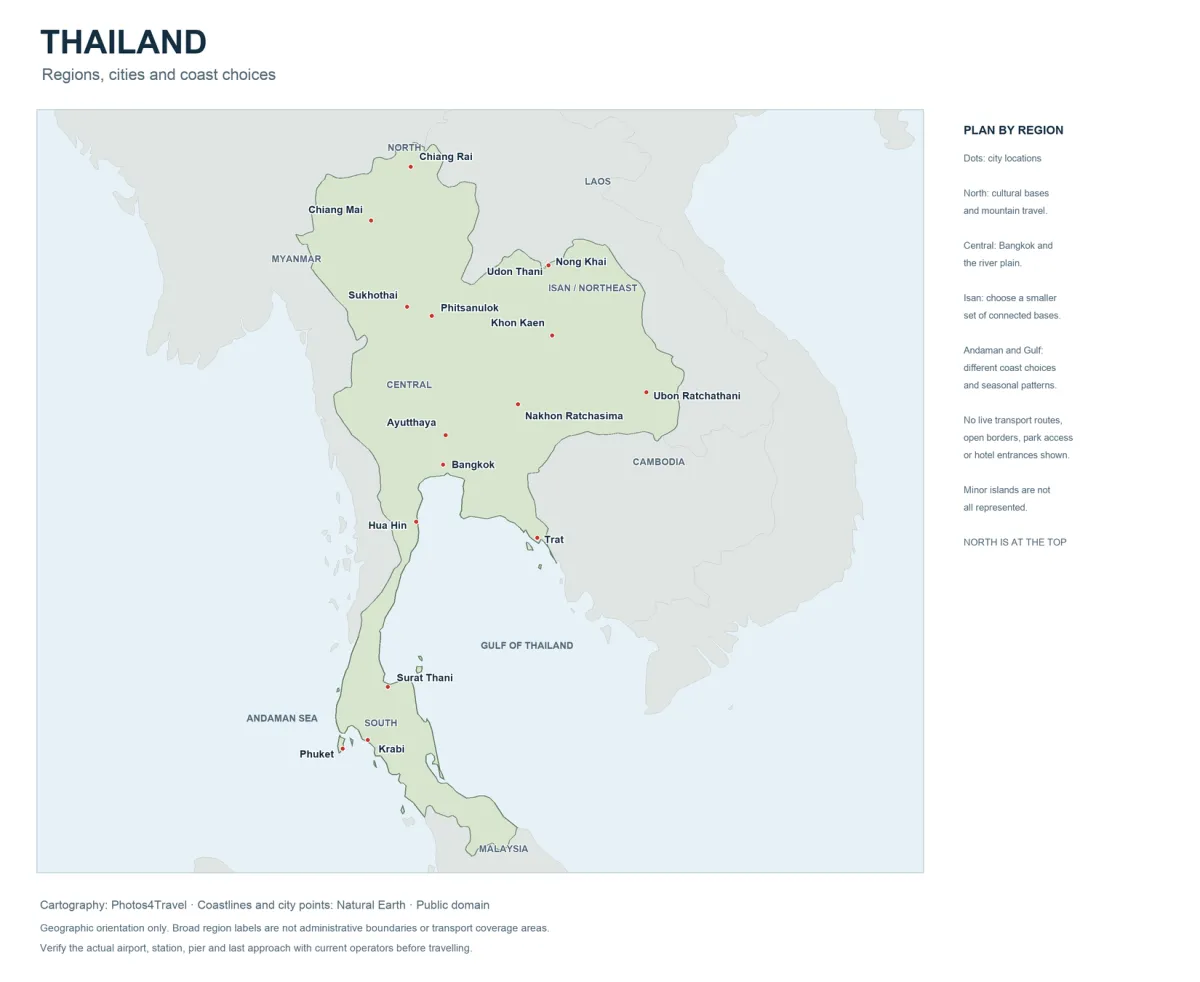
Opens in a new tab. Your browser may first fit the map to the screen; click the image to view its original size.
Thailand stretches from northern mountain valleys through the central plains to a long southern peninsula. Use this geographic map to choose connected bases and to understand which journeys involve a flight, a substantial overland leg or an additional boat transfer.
How to read the map
The map uses Natural Earth coastline and populated-place data. City points identify geographic locations; they do not mark hotel entrances, rail platforms or ferry piers. Regional names describe broad travel areas rather than official tour zones. Minor islands and local roads are outside its purpose, and no lines imply a current transport service or an open border crossing.
Use it in two steps. First, identify where your priorities lie relative to Bangkok and each other. Second, check the actual transport and last approach for the places you choose. A straight line on a map says little about mountain roads, traffic, a change of terminal or a sea crossing. The Getting Around guide turns that geographic outline into travel decisions.
Thailand's neighbours are Myanmar to the west and northwest, Laos to the north and east, Cambodia to the southeast, and Malaysia at the southern end of the peninsula. Regional travel warnings and border operations can change. This orientation map does not establish that an international crossing is open or suitable for a visitor.
Bangkok and the central plains
Bangkok is the main gateway and a practical starting point for the central region. The Chao Phraya River helps explain the older city, river transport and the location of several major temples. Modern rail corridors make other districts useful bases, but the central city still contains substantial distances. Choose a daily cluster of stops rather than moving between opposite ends of Bangkok repeatedly.
Ayutthaya lies north of Bangkok and can be a day trip or an overnight historical stop. Its ruined temple complexes occupy a real city and surrounding area, not a single enclosed museum site. A bicycle, local driver or guided visit changes what you can cover; heat and road comfort matter. Kanchanaburi is west of Bangkok and deserves a different route rather than being treated as next door to Ayutthaya.
Hua Hin sits down the upper Gulf coast. It can suit a mainland beach stay when you prefer to avoid an island crossing. Its shoreline and urban setting offer a different holiday from Krabi's limestone bays. The connection is overland from Bangkok; airport proximity on a map should not be used to assume a convenient scheduled flight for your dates.
Northern Thailand
Chiang Mai is a useful northern hub for temple visits, food and carefully chosen countryside excursions. Its old city is compact relative to Bangkok, but mountain parks and outlying districts are separate journeys. Staying inside or near the old city does not place every trekking or wildlife activity within walking distance.
Chiang Rai lies farther northeast. Consider it as an additional base if its particular cultural sites and surrounding landscape are priorities. It adds an overland move or a separate flight decision. A long guided day from Chiang Mai may be possible, but compare the time seated in a vehicle with the time spent at each stop before choosing it.
Sukhothai is south of these northern hubs and brings a distinctive historical-park landscape. The modern town, historical park and transport arrival point should be distinguished when selecting accommodation. A stay close to the park favours early visits; a modern-town base may offer a different choice of food and onward transport.
Isan and the Mekong corridor
Isan covers the broad northeastern region. Nakhon Ratchasima, Khon Kaen, Udon Thani and Ubon Ratchathani are useful orientation points, but the distance between them matters. A route through the northeast should be built around a smaller set of cities and local trips rather than a daily succession of distant provincial capitals.
The Mekong forms part of Thailand's border with Laos. River towns such as Nong Khai and Chiang Khan appeal for their waterside setting and local rhythm. They are distinct places with different approaches. A hotel described as “Mekong region” could be far from the specific promenade or town you have in mind.
Food and archaeology can justify a longer Isan journey, particularly for returning visitors. Allow time for a local driver or onward road connection where needed. Do not assume the same density of English-language booking options, late-night transfers or public transport found on the busiest tourist circuit.
The Andaman coast
Phuket is a large island connected to the mainland by road. Its airport, old town and west-coast beaches are separate areas; choosing the province does not resolve the hotel location. A beach resort can require a substantial road transfer, and travel between beaches may be less convenient than a small map suggests.
Krabi is both a province and the name used for its town and airport. Ao Nang is a mainland resort base, while Railay is normally approached by boat. Choosing Railay means considering luggage, tide, sea conditions and the last available transfer. A mainland room and a boat-access room are different practical products even when both appear under “Krabi”.
Ko Lanta lies farther south and generally suits a slower beach stay. Confirm the route used by your transfer and any seasonal boat alternative. Khao Sok is inland; the village area and Cheow Lan Lake access are different locations. A photograph of floating accommodation should not be read as the view from every hotel marketed under the national park's name.
The southern Gulf and eastern islands
Samui, Phangan and Tao lie off the eastern side of the southern peninsula. Samui has its own airport; other arrival strategies involve a mainland airport and an onward ferry. These are not equivalent arrival times. Check whether a combined ticket includes the road transfer, which pier is used and what happens if weather interrupts the crossing.
The eastern islands, including Ko Chang and Ko Kut, sit in a different part of the Gulf near Trat. They should not be grouped with Samui as though they share a single local transfer network. Road approach, pier, boat service and final accommodation transfer all belong in the plan.
For a shorter holiday, one coast is usually enough. Changing coasts can consume much of a day once packing, road travel and boat schedules are included. The beach guide compares the holiday character and seasonal trade-offs, while itineraries shows when a regional combination is worthwhile.
Choose a base for your travel style
For a first visit without driving, start with places that have several transport choices and useful services near the hotel. Bangkok, Chiang Mai and a well-connected beach base are easier to combine than a chain of remote accommodation. This does not mean staying beside the busiest nightlife street; quiet rooms and transport access can be assessed separately.
For photography, favour fewer bases and more opportunities to revisit nearby viewpoints in different light. For families, consider food, shade, laundry and a manageable final transfer. For travellers with mobility needs, check the entire route to the room, including a pier or steep lane. Geographic closeness alone cannot establish accessibility.
Scroll sideways on smaller screens to compare all columns.
| Area | Useful starting base | Check before combining |
|---|---|---|
| Central Thailand | Bangkok / Ayutthaya | City transport versus separate historical day trips |
| North | Chiang Mai / Sukhothai | Intercity time, haze and actual hotel approach |
| Northeast | A selected Isan city | Local road connections and return transport |
| Andaman | Phuket / Ao Nang / Ko Lanta | Beach location, boat access and season |
| Southern Gulf | Samui or a mainland gateway | Airport-plus-pier connection and weather |
| Eastern islands | Trat mainland approach | Pier, crossing and last accommodation transfer |
Frequently Asked Questions
Does the map show a driving route?
No. It shows geographic orientation using real coastline and city-point data. Use current operator and navigation maps for an actual journey.
Is Railay the same as Krabi town?
No. Railay is a boat-access peninsula area in Krabi province; Krabi town and the airport are separate locations.
Can I visit both coasts in one week?
It is usually more useful to choose one coast. The extra transfer can cost a large part of a short holiday.