
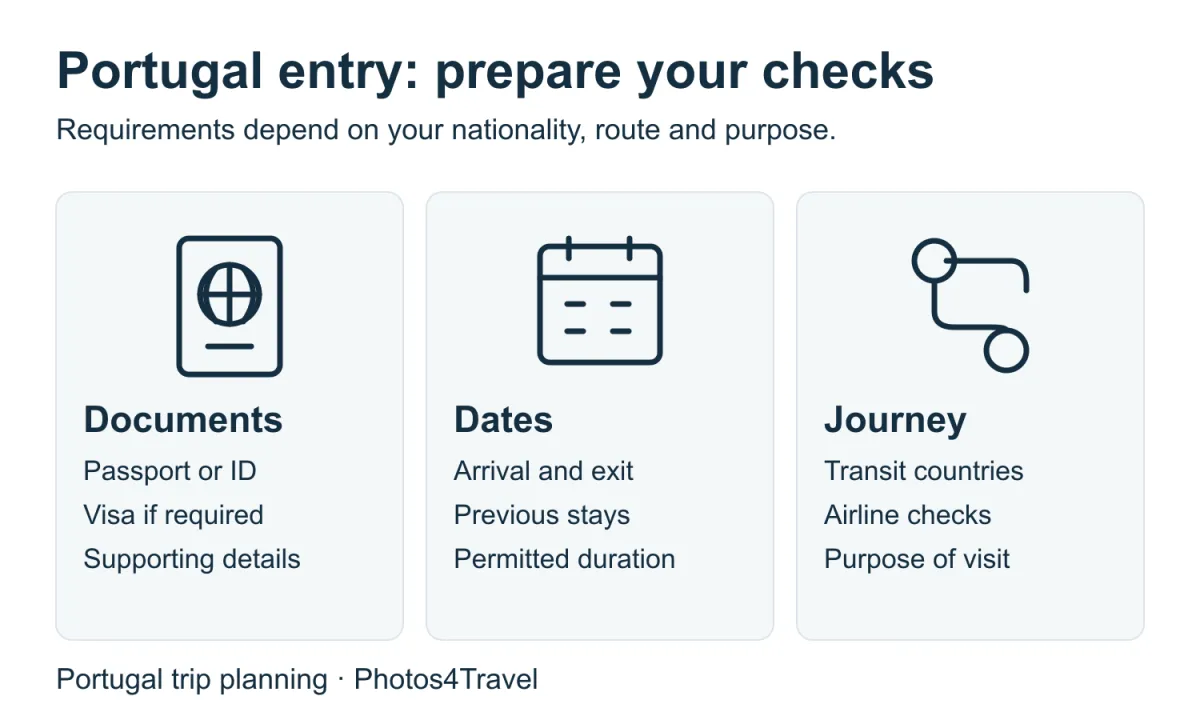
Entry planning depends on your nationality, passport or identity document, residence status, journey and purpose of travel. A country guide cannot determine an individual's permission to enter Portugal. Use this page to organise the checks, then confirm the requirements through official EU and Portuguese information and the relevant consular service. Portugal's mainland, Madeira and the Azores belong to the same country, but flights and journeys can involve other jurisdictions and border procedures. Check every transit point as well as the final destination. The short-visit questions here are separate from deciding where to live or whether you may work. Longer Stays & Costs covers the practical budget for an extended stay, while immigration eligibility requires the correct official process.
Start with your documents and purpose
Write down each traveller's nationality, document type and expiry date, including children. Then identify whether the trip is tourism, a family visit, study, work or another purpose. A requirement described for an ordinary tourist may not apply to another purpose or a different travel document. Travelling with an EU family member or holding a residence document can also change the applicable rules; use the relevant official guidance for that situation.
Check requirements before buying inflexible travel. A passport, a visa and a residence document serve different functions. A booking confirmation does not grant entry, and an accommodation host cannot decide immigration eligibility. Keep the official guidance you used with the travel record and review it again close to departure if the trip is months away.
Passport validity for non-EU visitors
Your Europe explains the usual passport conditions for non-EU visitors: a passport issued within the preceding ten years on entry and valid for at least three months after the intended departure from the EU. It also notes that supporting documents may be requested. Check the exact rule applicable to your document and circumstances rather than using only the printed expiry date. Special cases require official confirmation.
Calculate the margin using the intended journey, including changes to the return date. A passport with many months remaining can still raise an issue if its issue date is outside the applicable limit. Ask the relevant consular authority about exceptions; do not assume an airline's booking system has checked them for you. Keep names on travel bookings consistent with the documents that will be used.
Short Schengen stays and the rolling calendar

For many non-EU short-stay visitors, the general framework is up to 90 days in any 180-day period across the Schengen area. Time in Portugal should not be counted as a fresh allowance separate from other Schengen visits. The European Commission provides an official short-stay calculator and information about the rules. Individual exemptions, agreements, visas and residence arrangements need their own checks.
Keep a list of previous entry and exit dates before planning a long visit. A casual calculation from “three months” can produce a different result from counting actual days. If uncertain, seek guidance from the competent authority before extending bookings. Changing from one Portuguese region to another does not reset an allowance. A return flight reserved for a particular date also does not prove that the stay before it is authorised.
Does your nationality require a visa?
Visa requirements vary by nationality and document type. Use official EU information and the appropriate Portuguese consular service to establish whether a short-stay visa is needed and which procedure applies. Avoid assuming that a friend with another passport follows the same process. A transit arrangement, residence document or previous visa may affect the assessment but should be checked specifically.
If applying, use the current official instructions for the responsible consulate or its identified service provider. Prepare the exact documents requested and allow time for the actual process. This guide does not promise an appointment or processing time. Do not treat a paid commercial form-filling service as an authority that can guarantee approval. Keep the original application information and payment records where needed.
ETIAS and EES are different systems
At the 13 October 2026 review, the official ETIAS FAQ states that ETIAS is not yet operating and applications are not being collected. Check the official EU site again for your travel date; do not pay a website claiming to provide a required live application while the official service says otherwise. ETIAS concerns qualifying visa-exempt travellers and is distinct from a visa or residence permit.
EES, the Entry/Exit System, concerns border records and processes for travellers within its scope. Use its official EU information to understand current procedures and exemptions. Do not confuse border registration with obtaining an advance travel authorisation. Allow practical time at an external border and follow the instructions given there. This page avoids relying on a predicted launch date, because a forecast is not the same as an operating service.
Supporting information at the border
Keep accommodation details, the purpose and duration of the trip and onward travel information available where relevant to the requirements that apply to you. An itinerary should make sense with the documents and dates presented. If staying with friends or family, check what supporting information the responsible authority requests rather than substituting a hotel reservation you do not intend to use.
Store essential details offline so a weak connection does not prevent showing a confirmation. Carry documents in the form required by the authority, not only as an inaccessible link in an email. A photograph of a document can be useful for recovering details if it is lost, but it is not automatically accepted as a replacement. Protect copies and avoid handing them to an unverified third party offering to speed up entry.
Transit countries and separate flight bookings


Check whether a connection remains airside, changes airports or requires collecting baggage and checking in again. A separate ticket can create a different transit situation from a through booking. Ask the airlines and relevant official authority about the actual itinerary and documents; a low fare alone does not show that the connection is possible. Consider overnight connections and any hotel that requires entering the transit country.
Reserve enough time for border procedures, baggage and terminal changes. When a connection is on separate bookings, the second carrier's obligations may differ if the first flight is delayed. Keep the relevant ticket conditions. The Airports & Transfers page helps with the Portuguese arrival leg, while the entry question depends on the countries and documents involved in the complete route.
Travelling with children or special documents
Children need their own appropriate travel documents, and additional permissions or evidence may apply when a child travels with one parent or another adult. Check the requirements of the countries and carriers involved and the rules applicable to your situation. Do not infer the answer from the absence of a question on a booking form. Allow time to obtain any required documents through the proper process.
For emergency travel documents, refugee or stateless travel documents, or other non-standard circumstances, seek specific official guidance before buying an onward journey. A document accepted for one route may have different conditions for another. Keep the relevant contact information available. Airlines can explain boarding procedures, but the competent immigration authority determines entry requirements.
An extended stay needs a separate assessment
If your plans exceed the permitted short visit or involve work, study or residence, identify the relevant Portuguese process before making commitments. A furnished rental, a remote job or money in a bank account does not by itself provide a right to stay or work. Check the applicable official national rules and obtain qualified advice where your situation requires it.
Plan accommodation and transport around verified permissions rather than trying to fit the legal position to a cheap booking. If a holiday becomes a potential move, reconsider the documents, healthcare, insurance and financial arrangements together. Avoid relying on a broad internet claim about residence or tax. Those questions can depend on facts this travel guide does not know, and the consequences extend beyond the sightseeing itinerary.
Prepare a final departure checklist
Before leaving, check the document details against all bookings, the dates against the rules applicable to you, and the transit plan against the actual flights. Review official ETIAS and EES information, any required visa and the documents needed at the border. Save accommodation addresses and onward travel confirmations offline, along with your own consular assistance page.
If an official source and a commercial travel page disagree, resolve the question through the responsible authority before departure. Do not substitute a guide's publication date for a current rule check. Keep a secure record of the information you relied on and allow time for problems to be resolved. Clear preparation reduces the chance that a document issue disrupts an otherwise well-planned trip.
Official information and sources
Linked practical information reviewed on 13 October 2026. Recheck current timetables, entry requirements, event programmes and access conditions before committing to bookings.