
RUSSIA · COUNTRY GUIDE
Map of Russia: Regions & Travel Geography
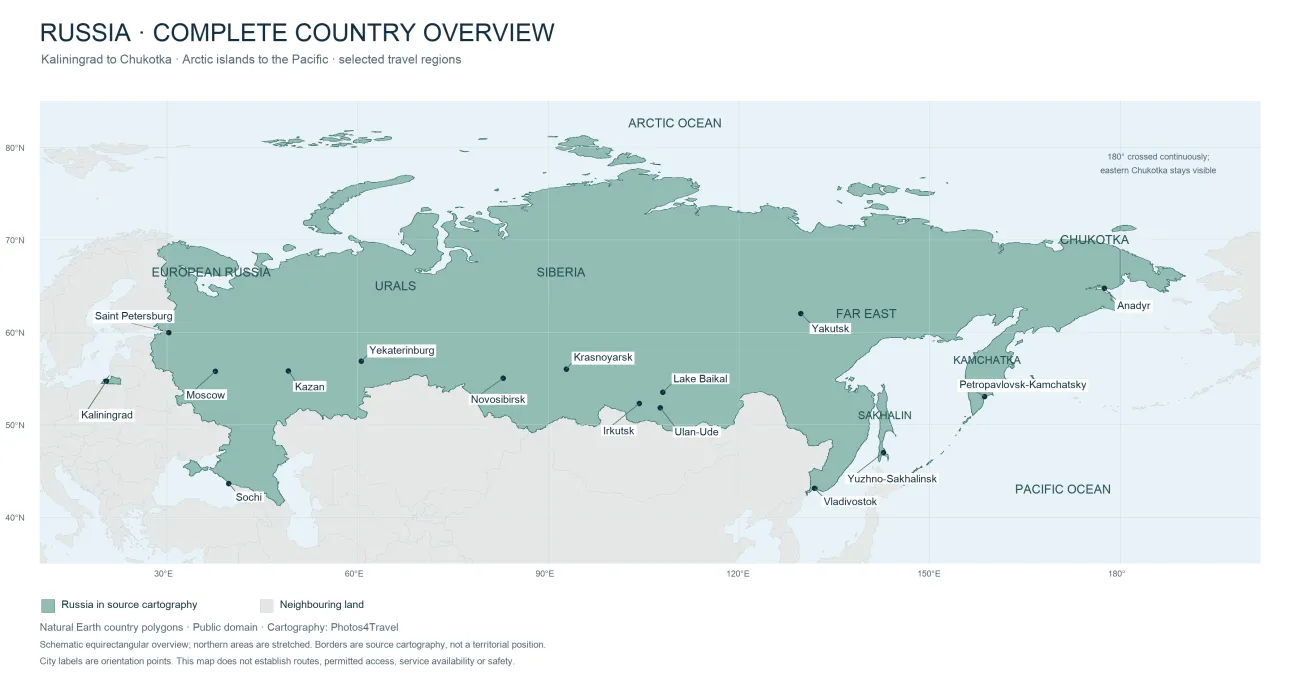
Russia's map is most useful when it helps you leave places out. Moscow and Saint Petersburg belong to a western-city itinerary; Irkutsk and Lake Baikal require a separate regional commitment; Vladivostok is on the Pacific. The distance between these settings is part of the travel experience and can consume days that a simple list of highlights hides.
The map above uses real Natural Earth land geometry and selected place coordinates. It shows the complete country extent with Russia highlighted against neighbouring land, including the Arctic islands and Chukotka beyond the 180-degree meridian. Source boundaries are cartographic context, not a territorial position; no live routes, permit zones or safety areas are depicted. Open the full-size version to read the labels. Use a current detailed map and the responsible authorities for navigation and access; this illustration cannot establish that a route is operating or permitted.
How to read this map
The labelled points show broad relationships between western cities, northern lakes, Siberia and the Far East. They are orientation points rather than exact entrances, stations or vehicle pickup locations. A city name on a country-scale map does not identify the building or shore you need to reach. Save the precise address separately.
Longitude and latitude lines help show the country's east–west extent. The map uses a simple geographical layout rather than a road-network model, so visual spacing should not be read as travel time. Routes follow operating railways, roads, flights and seasonal links; there may be no practical direct connection between two nearby-looking points.
The underlying land data are Natural Earth public-domain data, with cartography prepared for this guide. No sovereignty judgement should be inferred from the source cartography or highlighting. All 101 Russia polygons in the source fit inside the image extent; northern areas are stretched by the schematic geographical projection. This page does not route visitors through Crimea or other occupied Ukrainian territory as a Russian holiday extension.
Western Russia: the most concentrated city corridor
Moscow and Saint Petersburg are the main focus of the itinerary examples because they can support a coherent city-and-rail plan when travel is otherwise justified. They offer different urban histories and collections, not duplicate versions of one experience. A daytime intercity train can connect them, but the complete journey also includes station access and the final accommodation transfer.
Veliky Novgorod is a separate historic city associated with the western region, while Vladimir and Suzdal sit northeast of Moscow. Do not confuse Veliky Novgorod with Nizhny Novgorod on the Volga. Similar-looking transliterations and broad regional labels can lead to the wrong ticket or a hotel many hours from the intended destination.
For Suzdal, think in two stages: the approach to Vladimir and the onward road connection. It is not a simple stop on the Moscow–Saint Petersburg high-speed corridor. Give that move its own time and confirm the return before adding a second transfer on the same day. The itineraries make those dependencies visible.
The Volga and Kazan
Kazan introduces a different regional and cultural setting through Tatar heritage and its fortified historic centre. It belongs in the plan because you want that experience, not merely because it appears between the western cities and Siberia on a map. Check the actual transport options, arrival point and accommodation base before deciding how many nights it needs.
A large river is not automatically a transport route for your intended dates. Do not assume that a river cruise, local boat or road bridge serves the same journey as a train. If water travel is part of the purpose, verify the operator, landing points, season and cancellation arrangements. A scenic river photograph cannot answer those questions.
Karelia, Lake Onega and Kizhi
Kizhi is on Lake Onega in Karelia. It is not an island in Lake Baikal, and the two lakes are thousands of kilometres apart. That distinction is important when comparing tour descriptions or images labelled only as northern Russia. The Kizhi Museum is the primary starting point for the island's visitor information.
An island visit involves a mainland base, a departure point, operating transport, time on the island and a return. Seasonal access and weather can determine feasibility. Do not interpret the existence of a museum or a boat in a photograph as evidence that a suitable service runs every day. Keep a mainland alternative and avoid a tight onward departure after the island return.
The Urals and Siberia
The Urals provide a broad geographical division between European and Asian Russia. Crossing that line does not create a uniform Siberian landscape or travel pattern. Siberia includes extensive urban and rural settings, major rivers and long distances; a single label on the map cannot represent its roads, climate or local access.
For a long rail journey, count the travel days and the time needed to recover at each stop. A train may be the purpose of the trip, but it is still shared accommodation with document, luggage and arrival-time implications. Do not treat a cross-country rail line as a free connection between several otherwise separate holidays.
Irkutsk and Lake Baikal
Irkutsk is an urban approach to part of the Baikal region. Listvyanka, Olkhon and other shores involve different road or seasonal connections. Choose a specific base before comparing accommodation or activities. An offer described as a Baikal transfer may cover a very different destination from the one shown in a favourite photograph.
Lake Baikal's scale makes a circuit or remote shore visit a substantial undertaking. UNESCO's Baikal description explains its ecological importance, but World Heritage status is not a transport or access permit. Check the responsible protected-area authority and actual provider for your chosen route, including the return and any seasonal restrictions.
The Pacific and Far East
Vladivostok lies on the Pacific side of the country and requires a separate regional travel decision. Hills and bays shape local journeys, while the approach from western Russia is a major commitment. A western-city week cannot absorb that move without replacing most of its original programme. Compare the purpose of the trip before adding the destination.
Naval, border and other restricted areas make detailed access checks important. A public-looking waterfront or road is not universal permission to enter or photograph. Use the Health & Safety guidance and current local instructions. The orientation map deliberately does not show supposed safe photography routes or access corridors.
Kaliningrad and the southern coast
Kaliningrad is a geographically separate Baltic region. Overland travel to it involves other countries and their current entry and border rules. Do not assume that a Russian visa establishes permission to transit through Lithuania or Poland. Flights and border operations also require their own current checks; a continuous-looking map does not settle the administrative journey.
The Sochi area on the Black Sea is a different coastal setting. Accommodation marketed under the same broad city name can be far apart along the coast or inland towards the mountains. Identify the actual beach, station, airport and hotel entrance. Beaches compares the shore types and explains why a sea view does not establish easy bathing access.
Turn geography into a practical plan
On small screens, scroll the table horizontally to read both columns.
| Planning step | What to establish |
|---|---|
| Choose the purpose | Art, a necessary family visit, a regional stay or a rail journey each creates a different route. |
| Fix the entry and exit | Check current advice, permitted crossing points, passport and visa conditions before selecting optional stops. |
| Choose exact bases | Name the city, neighbourhood or shore village; a broad regional label is insufficient. |
| Mark transfer days | Include the last approach and return, not only the fastest advertised transport segment. |
| Count nights | Reconcile every accommodation night with arrival, departure and any overnight transport. |
| Leave alternatives | Keep weather-sensitive and separate-ticket connections away from critical departures where possible. |
Current UK advice is against all travel to Russia and the US advisory is Level 4, Do Not Travel. Check official advice, insurance and your own nationality's entry rules before using any route example. The map explains geography; it does not assess the safety or legal feasibility of a journey.
Use Top Destinations to compare the places themselves and Getting Around for airports, rail and local connections. When you move to a detailed navigation map, check the exact address and current access instead of using an orientation label as the final destination.