
Sign in
For Photos4Travel editors and team members.
Dominican Republic · Travel Costs & Money
Dominican Republic Travel Costs & Longer Stays
A Dominican Republic travel budget depends more on the shape of the holiday than on a single daily figure. A prepaid resort stay, a city-and-beach route and four weeks in an apartment distribute costs differently. The cheapest room can become expensive if every meal and beach visit requires transport; a higher room price can be reasonable when it includes services you would otherwise buy.
Build the budget around nights, people and the meals actually covered. Then add transfers, activities and the costs that are easy to miss on a booking screen. The examples below distinguish published prices checked on 18 November 2026 from an explicitly illustrative planning model. The model is not an accommodation offer, a national average or a promise of availability.
Start with the whole trip
Write down the number of calendar days and paid nights separately. A seven-day trip commonly has six nights, while 28 nights normally span 29 calendar dates. Flight times affect how many meals you buy, but an arrival or departure day can still need a transfer, drinking water, luggage storage or an extra meal. Counting only full sightseeing days leaves predictable gaps.
Separate per-person and shared costs. A room or private vehicle may be priced for the party, while admission, a coach seat or a meal is usually priced per traveller. For two adults, dividing every quoted number by two is as misleading as doubling the room total. Check whether children change the room category, breakfast arrangement or transfer vehicle.
Keep refundable deposits outside the spending subtotal but inside the cash-flow plan. A car or apartment deposit may temporarily reduce the money available on your card. Record when it is charged or held, how it is released and any currency conversion. A promised refund is not money available to pay an unrelated bill during the trip.
Real price examples: what they do and do not prove
The official Adrian Tropical menu lists a standard mofongo at RD$414 and a chinola juice at RD$149. Those two items total RD$563 before additions; the menu says prices exclude taxes. This is a useful named restaurant example, not a claim that every meal in the country costs that amount or that the final bill is RD$563.
Check whether a restaurant’s displayed prices include ITBIS and the service charge. Dominican tourism guidance identifies an 18% sales tax and a separate 10% service charge. They are different bill lines; an additional discretionary gratuity should not be confused with either. Ask for the final amount when the menu is unclear rather than comparing a tax-exclusive menu with an all-in bill elsewhere.
Transport also needs its unit explained. OPRET publishes RD$20 for an urban Metro ride, but a first purchase can include a card charge. A rechargeable card with its minimum two rides costs RD$100 altogether. A traveller making only one journey should compare the appropriate single-use product instead of treating RD$100 as the ride fare.
For mobile data, Altice’s published packages include 10GB for 30 days at RD$849, taxes included. Activation or a SIM can be separate. Package validity, calls and the data allowance matter more than a headline “from” price. Recheck the offer before buying; a published package does not establish usable reception inside a particular rental.
Compare accommodation on matching terms
For a hotel, compare the same dates, occupants, room category, cancellation conditions and meal plan. “Breakfast included” and “all-inclusive” should be checked against the actual booking terms. Airport transfers, particular restaurants, premium drinks or activities can have separate conditions. Do not infer inclusions from photographs or a property’s general description.
For a kitchen-equipped unit, ask for the complete stay total. Cleaning, electricity, laundry, parking and a refundable security deposit can sit outside the first displayed price. Find out whether electricity is included, capped or metered, and how any meter reading is recorded. An apparently low nightly rate is not directly comparable with an inclusive hotel total until those items are resolved.
Compare the surroundings as part of the price. A workable kitchen needs an accessible place to buy food; an apartment marketed as walkable may still involve a difficult road crossing. Ask how you will reach supplies, the beach and transport without a car. Paying more for a suitable location can remove repeated journeys without requiring you to cut the activities you came for.
A transparent 28-night planning model
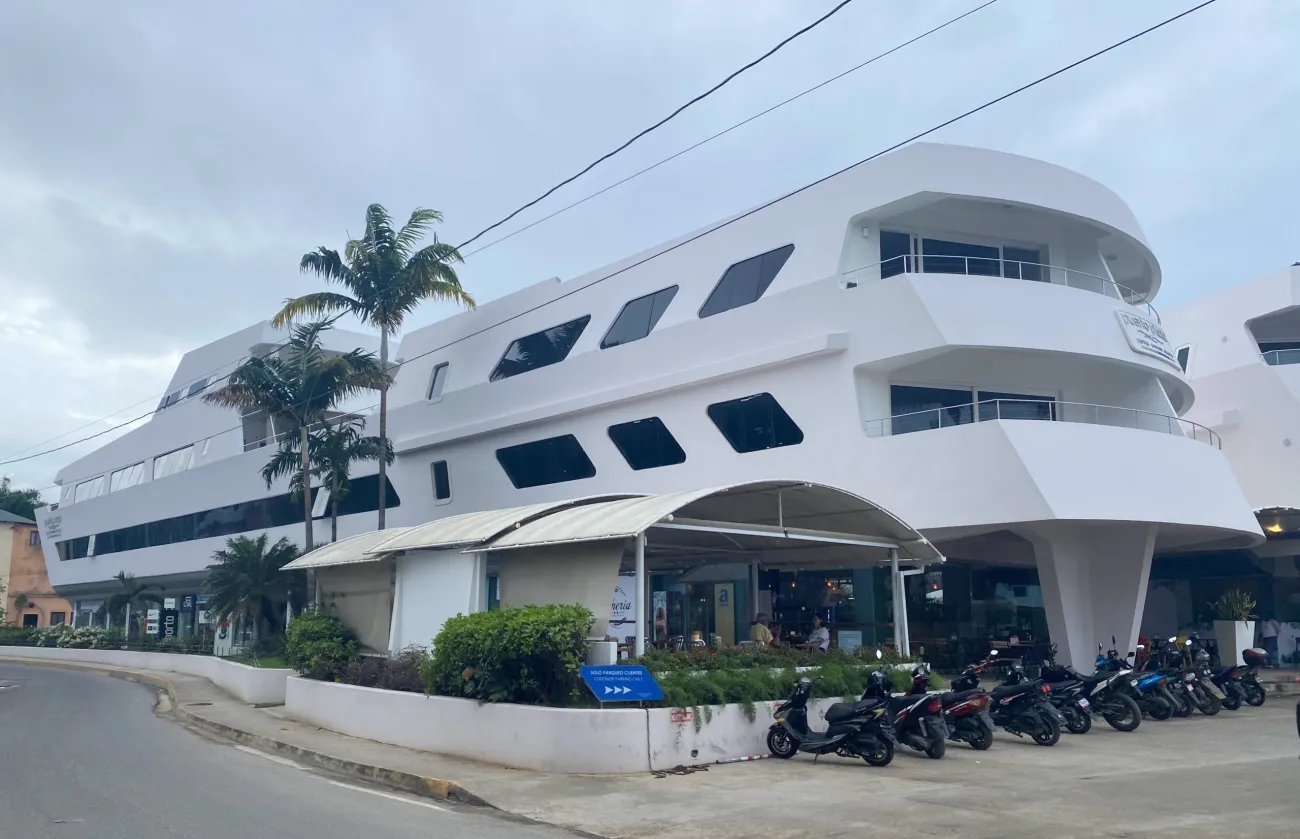
Photo: -wuppertaler · DOM Las Terrenas, Calle Francisco Alberto Caamaño Deñó 0003.jpg · CC BY 4.0.
The following model is for two adults sharing one kitchen-equipped unit for 28 nights and 29 calendar days. Lodging, food, transport and incidentals are chosen budget allowances, not observed market prices or a bookable quotation. The mobile line uses the named published package above. Replace each allowance with your own confirmed offer before making a commitment.
Swipe or use the arrow keys to read the assumptions and totals.
| Cost | Explicit assumption | Couple total |
|---|---|---|
| Accommodation | 28 nights × assumed RD$3,000 per unit; all lodging charges must fit this allowance | RD$84,000 |
| Food and groceries | 29 calendar days × assumed RD$1,500 for both adults | RD$43,500 |
| Transport allowance | Assumed pooled amount for local rides, intercity travel and transfers; no rental car | RD$10,000 |
| Mobile data | Two Altice 30-day 10GB packages × RD$849; SIM or activation extra | RD$1,698 |
| Incidentals | Assumed allowance for ordinary small purchases | RD$6,000 |
| Subtotal | These five categories only | RD$145,198 |
| Contingency | 10% of the subtotal, rounded to the nearest peso | RD$14,520 |
| Model total | Subtotal plus rounded contingency | RD$159,718 |
For easy comparison only, using an assumed RD$60 to US$1 gives approximately US$2,662 for the couple, or US$1,331 per adult. This is an arithmetic assumption, not a live exchange rate. Use your bank’s actual conversion and charges when paying.
The model excludes international flights, insurance, major paid excursions, card or ATM fees, refundable deposits and any cleaning, electricity or tax charge not absorbed into the stated lodging allowance. It is therefore a base-stay model, not a complete total for every holiday. If your confirmed apartment price exceeds the allowance, change that line rather than pretending the model proves the offer is expensive.
Twenty-eight nights also leave little room to ignore immigration dates. Count the actual entry and departure days and check the authorised stay; an accommodation booking is not permission to remain. A delayed flight or an added stop can change the calendar calculation. Longer-stay planning should include the relevant entry or extension check as well as the household budget.
Control costs without making the trip difficult

Photo: LittleT889 · Yaroa.jpg · CC BY-SA 4.0.
Keep fewer overnight bases if each move adds transfers, luggage handling and a lost part of the day. Combine nearby activities rather than repeatedly crossing the same region. A day with no hotel change can still be varied, and a slower route may leave room for a paid experience you value more than another long drive.
Compare a private transfer by vehicle with coach tickets plus both terminal journeys. For a group, the difference can be smaller than it first appears. For a solo traveller, a scheduled service may make more sense if the timings and last approach work. Price the actual journey rather than declaring one transport type universally cheaper.
Ask about cancellation and weather arrangements before buying boat trips or outdoor activities. A lower non-refundable price may be less useful when you have only one available day. Reserve enough money for essentials and a revised departure plan rather than spending the entire remaining balance on optional activities.
Dominican Republic budget FAQ
Is the 28-night example an available apartment offer?
No. It is an illustrative model with stated allowances. Replace the accommodation line with a real quote and check all additional charges.
Why does a 28-night stay use 29 food days?
It spans arrival through departure across 29 calendar dates. Your actual meals depend on flight times and inclusions, so adjust the allowance accordingly.
Are the restaurant examples final bill prices?
No. The named menu states that its prices exclude taxes. Check the applicable additions and the final bill before comparing it with an inclusive price.
Should I budget in dollars or pesos?
Keep the quoted currency for each item and label every conversion assumption. Local expenses are easier to compare in pesos; foreign-currency hotel quotes need their own terms checked.
Can I spend the contingency on tours?
You can choose how to allocate money, but doing so removes the reserve for changes. Keep essential transport, health cover and the departure plan funded first.
Last updated: