




Sign in
For Photos4Travel editors and team members.
USA · LAS VEGAS GUIDE
Where to Stay in Las Vegas: Choose the Right Area

Choose your Las Vegas area before choosing a hotel. The right base reduces the journeys you repeat every day: getting to a show, returning after dinner, reaching a conference or taking a break between sightseeing sessions. This guide compares locations. For named properties and room considerations, continue to Las Vegas hotels.
For a first visit built around the classic resort landmarks, we would start by comparing central Strip locations. Choose Downtown if its museums and evenings are the main reason for your trip. Off-Strip accommodation can work well, but only when the exact location and total transport cost make sense for your plans.
Choose your area at a glance
On smaller screens, swipe or scroll horizontally to read the full table.
| Area | Best suited to | Main trade-off |
|---|---|---|
| Central Strip | First visits with several resort landmarks, restaurants and shows | Busy surroundings; check room location and total cost |
| South Strip | Trips focused on south Strip resorts, shows and event venues | Other Strip areas still need a separate walk or ride |
| North Strip and convention corridor | Specific northern resorts, events and convention access | Check the exact venue entrance and station rather than relying on a broad area label |
| Downtown and Fremont | Museum visits and evenings around Fremont | Separate transport is needed for a Strip-focused programme |
| Off-Strip and outer-valley stays | A particular resort, road trip or longer stay with suitable facilities | Potential car, parking and repeated ride costs |
These are practical planning areas, not official district boundaries. Use the map to check individual locations and the transport guide to test your route.
Central Strip: a straightforward first-visit base
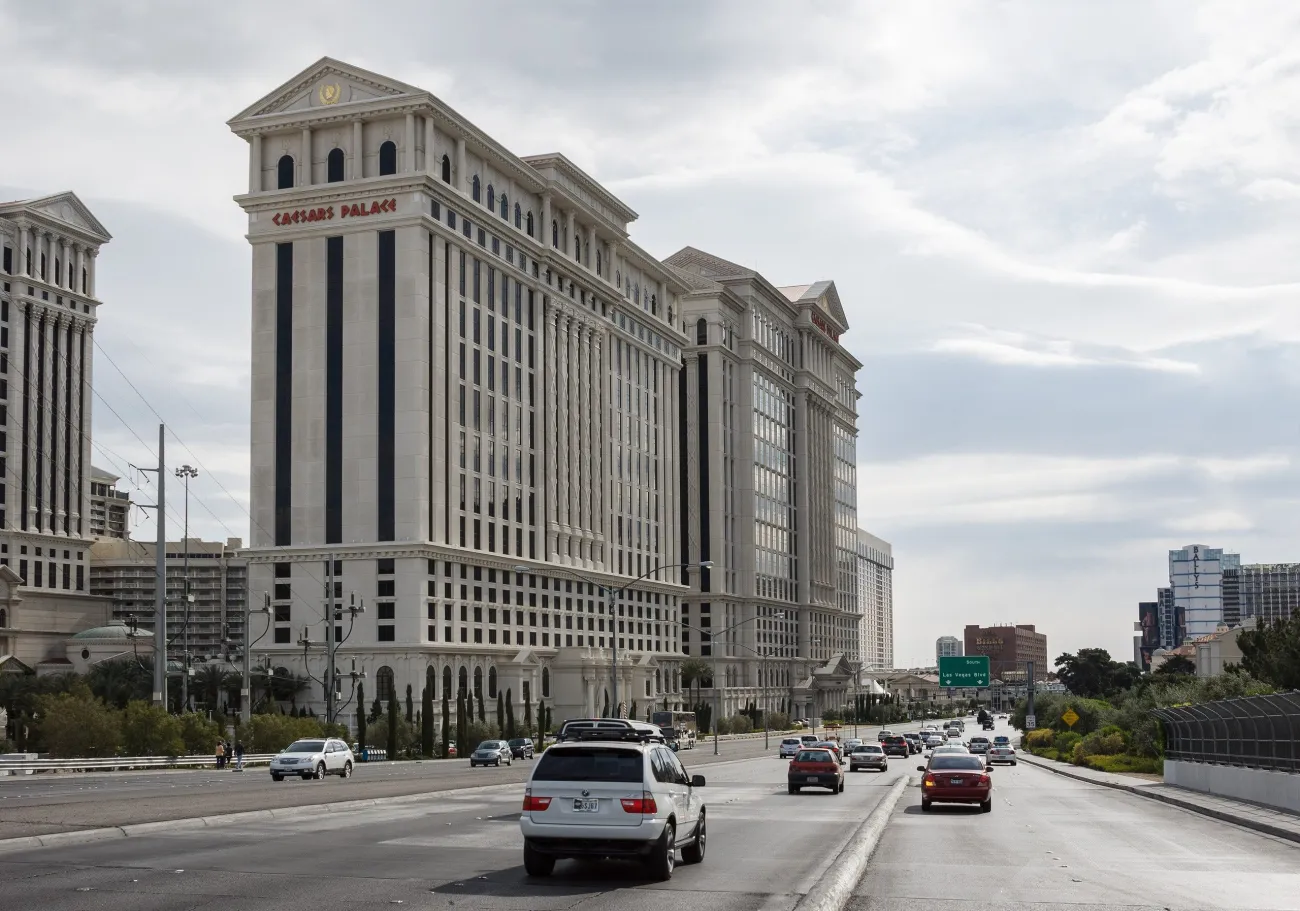
A hotel near the places you expect to revisit lets you break the day into smaller outings rather than staying out from breakfast until late at night. For a landmark-focused first trip, compare the area around Bellagio, Paris, Caesars Palace and The LINQ, then check the hotel entrance against your evening bookings.
The benefit is variety around your base, not an assumption that everything is a short walk. Large resort grounds, footbridges and internal corridors add distance. Two properties that appear adjacent on a simplified map can have entrances on different sides of their sites.
Before choosing a room, ask whether you want a view, quiet or convenient lift access. A low room price does not tell you where the room sits within a complex. Look at the booked tower and room category, then review the cancellation conditions. Use the hotel guide to compare properties after you settle on this area.
South Strip: choose it around your actual plans

The south Strip is a useful base when your main attractions, shows or event venue are in this part of Las Vegas. The corridor includes the MGM Grand and the resort cluster around New York-New York, Excalibur, Luxor and Mandalay Bay. This is a location decision rather than a single style or price category.
It can be tempting to select a hotel because it looks close to the airport. Airport access still depends on terminal pickup, roads and the hotel entrance, so check your transfer separately. For an itinerary with several evenings farther north, compare the extra journeys before choosing the cheapest quote.
Families should inspect the booked property's current pool, room occupancy and entertainment rules. Visitors attending a stadium or arena event should use the organiser's current arrival information; the map distance alone does not describe controlled entrances or event-day routes.
North Strip and the convention corridor

Stay near a northern resort because you want that resort or because your plans repeatedly bring you to that area. This can be a good choice for a slower resort stay, a particular show or an event with an appropriate nearby entrance. It is less compelling if almost every day takes you back to the central or southern Strip.
Convention visitors should identify the building and hall as well as the venue name. The Convention Center, The Venetian Expo and other meeting venues are not interchangeable locations. The Monorail station map helps compare several east-side connections, but station access and the walk within the venue still count.
Do not assume a property described as near the Strip is positioned on Las Vegas Boulevard. Check its address, entrance and transport route. A hotel that works well for a conference may be a less convenient base for a different visitor's evening plans.
Downtown and Fremont: choose it for a Downtown trip

Downtown is a distinct part of the city, with the Fremont Street Experience, Fremont East, museums and the Arts District providing different reasons to spend time here. The City of Las Vegas Downtown guide is useful for understanding those relationships.
A Downtown base works particularly well if you want to return to Fremont in the evening after a museum visit, or if you prefer to explore independent dining and arts areas on separate outings. It can also make a repeat visit feel different from another stay inside a Strip resort.
Compare noise exposure carefully when booking near an entertainment district. Ask the property about the room's location and current nearby programming rather than relying on a request for a quiet room. Downtown is not automatically the least expensive choice for every date, and an apparently cheaper room may be less useful if you travel to the Strip several times a day.
Off-Strip: compare the exact location

Off-Strip is a broad description, not a guarantee of price, quiet or easy access. It can mean accommodation a short ride from the resort corridor, an airport-oriented hotel, a convention property or an outer-valley resort. Treat each as a separate transport decision.
For a car-based trip, check parking terms and the route you will drive most often. For a car-free stay, test the journey to your main evening destination, including the last service or return pickup. Do not assume a hotel provides a complimentary shuttle unless its current booking information confirms the route, operating times and eligibility.
Longer stays may benefit from a kitchen, laundry or more room to spread out. Verify those facilities for the precise room type rather than inferring them from a suite label. Add any housekeeping or parking charges to the comparison.
Match the area to the trip
- First visit without a car: start with an area close to your main evening plans, and group sightseeing by neighbourhood.
- One special show: compare the return journey before and after the performance, not just the daytime distance.
- Conference: choose for the actual building entrance and the journey you will repeat each morning.
- Photography: a convenient base can make it easier to return for changing light; it does not replace checking access rules at each viewpoint.
- Family: compare room occupancy, food options, pool rules and the ease of returning for a break.
- Road trip: consider parking and the direction of your next day's drive alongside resort facilities.
Compare the full stay cost
Put the full stay totals beside each other for the same dates, guest count and cancellation conditions. Include mandatory charges, taxes, parking, airport travel and the repeated journeys your chosen area creates. A better location may be worth more than an upgrade you will barely use.
Room availability and terms vary by date. Use Travel Costs & Money to build the comparison and Hotels for specific property choices. Reserve dining or entertainment only after checking that the programme works from the chosen base.
Travel TipMap the hotel against your two most important destinations before comparing room rates. Check the final walking and transport routes that you would actually use.
Frequently asked questions
Is the Strip or Downtown better for a first visit?
For a first trip focused on the well-known resort landmarks, a suitably located Strip base is our starting recommendation. Choose Downtown when its museums, Fremont evenings and surrounding neighbourhoods are the main focus.
Which part of the Strip is best without a car?
Choose the part closest to the activities you expect to repeat. Central locations can reduce transfers for a mixed first-visit programme, but the actual hotel entrance and your booked venues matter more than a broad label.
Are Off-Strip hotels always cheaper?
No. Compare a complete quote for your dates and add transport and parking. A lower room-only rate is not enough to establish a cheaper trip.
Should I split a short stay between the Strip and Downtown?
Usually choose one base for a short trip. Packing, checking out and waiting for the next room can consume sightseeing time. A split becomes more useful when each part of a longer stay has a different purpose.
Can I choose a hotel just because it has a Monorail station?
Use a station as one part of the decision. Check whether the Monorail connects your actual destinations and include the walk between your room, the station entrance and the final venue.
Tours, Tickets & Experiences
Las Vegas Travel Tips & Inspiration