
User login
Dominican Republic Fast Facts
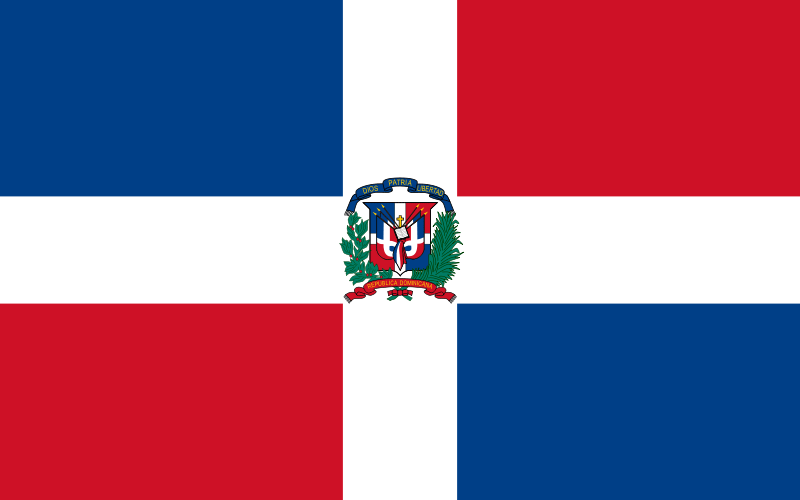
These Dominican Republic fast facts provide essential information for travelers who want a clear and practical overview of the country before planning their trip. From geography and population to language, currency and time zone, this page answers the most common questions in a simple, travel-focused format.
Geography & Location
The Dominican Republic is located in the Caribbean, occupying the eastern two-thirds of the island of Hispaniola, which it shares with Haiti. It lies between the Atlantic Ocean to the north and the Caribbean Sea to the south, giving the country access to two very different coastlines.
Geographically, the country is one of the most diverse in the Caribbean. It features white-sand beaches, mangrove coastlines, fertile valleys, dry desert-like regions and the highest mountains in the Caribbean. Pico Duarte, the tallest peak, rises above 3,000 meters, while Lake Enriquillo sits below sea level.
Capital & Major Cities
The capital city is Santo Domingo, the oldest continuously inhabited European settlement in the Americas. It is home to the Colonial Zone, a UNESCO World Heritage Site, as well as the country’s main government, cultural and economic institutions.
Other important cities include Santiago de los Caballeros, the country’s second-largest city and a major cultural hub, as well as tourist-oriented areas such as Punta Cana, Puerto Plata, La Romana and Samaná.
Population & Culture
The Dominican Republic has a population of over ten million people. Dominican culture is shaped by a blend of Spanish, African and indigenous Taíno influences, reflected in music, food, traditions and daily life.
Music and dance play a central role in Dominican identity. Merengue and bachata originated here and remain an important part of social life. Family ties, hospitality and a relaxed approach to time are common cultural characteristics travelers quickly notice.
Language
The official language is Spanish. English is widely spoken in tourist areas, hotels and resorts, but basic Spanish is helpful when traveling independently, especially in smaller towns and rural areas.
Currency & Payments
The official currency is the Dominican Peso (DOP). In many tourist areas, US dollars are also accepted, particularly for tours, accommodations and large purchases. However, local currency is usually required for everyday expenses, public transport and smaller businesses.
Credit and debit cards are widely accepted in hotels, restaurants and shopping centers. ATMs are common in cities and tourist zones, though access may be limited in remote areas.
Time Zone
The Dominican Republic operates on Atlantic Standard Time (AST). The country does not observe daylight saving time, which makes time differences consistent throughout the year.
Electricity & Plugs
Electricity runs on 110 volts with type A and B plugs, the same as in the United States. Travelers from Europe and other regions will need a plug adapter and possibly a voltage converter for certain devices.
Climate & Weather Overview
The Dominican Republic has a tropical climate with warm temperatures year-round. Coastal areas are generally hot and humid, while mountainous regions are cooler. Weather conditions can vary between the Atlantic and Caribbean coasts, with the north often receiving more rainfall.
Sea temperatures remain warm throughout the year, making swimming, snorkeling and water activities possible in all seasons.
Government & Political Structure
The Dominican Republic is a democratic republic with an elected president and a multi-party political system. It has one of the largest and most stable economies in the Caribbean, supported by tourism, agriculture, manufacturing and services.
Religion
Christianity is the dominant religion, with Roman Catholicism historically playing a major role. Religious tolerance is widely practiced, and travelers of all backgrounds generally feel comfortable throughout the country.
Driving & Transportation Basics
Driving is on the right-hand side of the road. Traffic conditions can be chaotic in large cities, while rural roads vary in quality. Car rentals are common in tourist areas, but many travelers prefer organized transport, taxis or private transfers.
For detailed information on getting around, see the Transportation Guide for the Dominican Republic.
Safety Snapshot
The Dominican Republic is generally safe for travelers, especially in tourist regions. As with any destination, common-sense precautions are recommended. Visitors can find detailed guidance in the Health & Safety section of this guide.
Why These Fast Facts Matter
Understanding basic facts about the Dominican Republic helps travelers plan more efficiently, avoid surprises and feel confident navigating local systems. This page serves as a foundation, while the rest of the travel guide explores destinations, activities and experiences in greater depth.