
Map of Barcelona
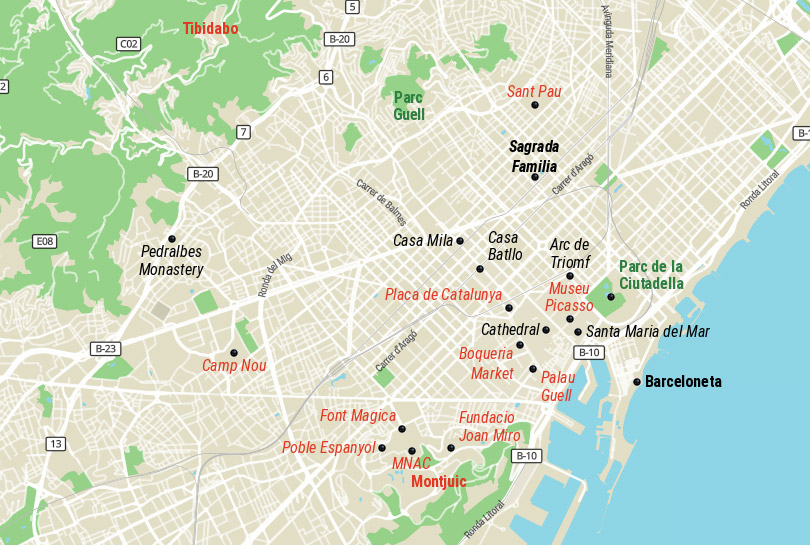
Map of Barcelona – Districts, Landmarks & Coastal Layout
Barcelona is a compact, walkable Mediterranean city, but its neighborhoods, hills and coastline are easier to understand with a good map. Looking at Barcelona from above, you see a clear structure: a historic core by the sea, a modern grid extending inland, hilltop viewpoints and long beaches running along the waterfront. This map-based overview will help you understand where everything is, where to stay and how to move around smoothly.
Understanding the Layout of Barcelona
On the map, Barcelona is framed by three main elements: the Mediterranean Sea to the southeast, the Collserola hills to the northwest and a structured grid in between. The oldest areas sit closest to the sea, while newer districts spread inland in neat blocks. Most visitors spend their time in a few key zones forming a natural corridor from the Gothic Quarter to the waterfront and up toward Park Güell and Montjuïc.
Barcelona Districts on the Map
Barcelona is divided into several districts, each with its own character. A city map will usually highlight these areas by color or name. Here is how they appear and what to expect when you zoom in.
Ciutat Vella (Gothic Quarter & El Born)
On the map, Ciutat Vella forms the historic core next to the sea. It includes the Gothic Quarter, El Raval and El Born. Streets here are narrow and irregular, contrasting sharply with the structured grid of Eixample above. This is where you find medieval lanes, hidden squares and many of Barcelona’s oldest landmarks.
Eixample
Directly above Ciutat Vella, Eixample appears as a perfect grid of square blocks with chamfered corners — one of the easiest districts to recognize on any Barcelona map. Major avenues like Passeig de Gràcia and Avinguda Diagonal run through this area, home to many Modernisme buildings, shops and restaurants.
Gràcia
North of Eixample, Gràcia has a more village-like feel with smaller blocks, intimate plazas and local shops. It is slightly uphill, offering occasional viewpoints over the city. Gràcia is known for its artistic personality and strong neighborhood identity.
Sants-Montjuïc
To the southwest, near the port and hillside areas, Sants-Montjuïc occupies a large section of the map. Montjuïc hill stands out as a green elevated zone filled with museums, gardens and Olympic sites. This district connects the city center with the harbor and cruise terminals.
Sant Martí & the Waterfront (Barceloneta & Poblenou)
Along the coastline, the map highlights the seafront districts of Barceloneta and Poblenou, both part of the Sant Martí area. Barceloneta, closest to the old town, has narrow streets and direct beach access. Poblenou stretches further northeast with long beaches, modern developments and wide avenues.
Other Residential Districts
Areas such as Les Corts, Sarrià–Sant Gervasi, Horta-Guinardó, Sant Andreu and Nou Barris appear mainly as residential zones on most maps. They are less central for short stays but essential parts of the city, offering local viewpoints, quieter neighborhoods and parks.
Key Landmarks on the Barcelona Map
A well-designed tourist map of Barcelona highlights major landmarks with icons or labels. Understanding where these places sit relative to each other helps you build a realistic itinerary.
- Sagrada Família: Located in Eixample, slightly northeast of the city center.
- Park Güell: Positioned on the hills above Gràcia with panoramic views.
- Casa Batlló & La Pedrera: Found along Passeig de Gràcia in central Eixample.
- Gothic Quarter: Just inland from the old port in Ciutat Vella.
- Barceloneta Beach: On the curved coastline southeast of the old town.
- Montjuïc: Overlooking the harbor from the southwest hillside.
For full itinerary ideas, see Things to Do in Barcelona.
Using the Metro & Transport Map
Many Barcelona maps also include metro lines, tram routes and train stations — extremely useful for planning fast connections between districts.
- Metro: Color-coded lines cover nearly all major neighborhoods.
- Major hubs: Plaça de Catalunya, Passeig de Gràcia and Sants Estació.
- Airport connections: Train (R2 Nord) and Aerobús to/from El Prat Airport.
- Tram lines: Serving the more modern areas in the east and west.
For detailed guidance, visit the Barcelona Transportation Guide.
Where to Stay – A Map-Based Overview
Checking the map before choosing accommodation helps you understand travel times and nearby attractions. Each district offers a different experience:
- Gothic Quarter & El Born: Extremely central — walkable to many landmarks.
- Eixample: Perfect for first-timers wanting restaurants, metro access and Modernisme architecture.
- Gràcia: Local, artistic and well-connected by metro.
- Barceloneta: Best for staying near the beach.
- Poblenou: Spacious, modern and ideal for longer stays.
Photography & Viewpoints on the Map
Barcelona’s map also serves as a visual travel tool. Many top photography spots align along a natural route between the hills and the sea.
- Park Güell: Iconic hilltop city views.
- Gràcia: Village-like plazas and atmospheric streets.
- Eixample: Geometric crossroads and Modernisme facades.
- Gothic Quarter: Narrow alleys and historic arches.
- Barceloneta: Sunrise views along the shoreline.
- Montjuïc: Sunset panoramas over the harbor.
For more inspiration, browse Barcelona Pictures.
Tips for Using Maps in Barcelona
Travel Tip
Use Google Maps offline by downloading the Barcelona area in advance. It works without mobile data and helps you navigate the metro, attractions and neighborhoods with ease.
Whether using a printed map or an offline mobile app, these simple tips make navigation easier:
- Save your hotel, key sights and nearest metro stations.
- Zoom out regularly to keep track of sea direction and major avenues.
- Use Gran Via and Avinguda Diagonal as orientation lines.
- Switch between street map and satellite view for parks and elevation.
Final Thoughts
Barcelona becomes easy to explore once you understand its basic shape: a historic old town by the sea, a modern grid behind it, local districts stretching uphill and panoramic viewpoints above everything. With this mental map in mind, every walk becomes easier and every landmark fits naturally into the wider cityscape.