
Sign in
For Photos4Travel editors and team members.
Dominican Republic · Best Time to Visit the
Best Time to Visit the Dominican Republic
For a first beach-and-city visit, December through March is a useful starting window to compare: coastal evenings are generally more comfortable than in late summer, and the Atlantic hurricane season has its official end on 30 November. That does not make every winter day dry or every beach calm. Choose the coast and activities as carefully as the month.
On this page · 7 sections ShowHide
The Dominican Republic has Atlantic-facing shores, a Caribbean coast and highlands where conditions differ substantially from a resort at sea level. This guide separates long-term climate averages from the forecast you need for a particular trip. A rainfall normal helps compare months; it cannot tell you whether a boat will sail or a trail will be suitable on your chosen day.
Punta Cana weather by month
The table uses the WMO 1991–2020 normals for Punta Cana station 78479, hosted by NOAA. The temperature column is the mean daily minimum, not the daytime high. Rainfall is the average monthly total. These are one coastal station’s historical normals, not a national forecast or a guarantee for a particular hotel.
Swipe or use the arrow keys to compare the monthly figures.
| Month | Mean daily minimum | Monthly precipitation |
|---|---|---|
| January | 21.2°C | 84.7 mm |
| February | 21.2°C | 62.8 mm |
| March | 21.7°C | 50.4 mm |
| April | 22.5°C | 64.9 mm |
| May | 23.5°C | 129.3 mm |
| June | 24.2°C | 93.7 mm |
| July | 24.2°C | 84.7 mm |
| August | 24.3°C | 106.7 mm |
| September | 24.1°C | 135.3 mm |
| October | 23.8°C | 123.6 mm |
| November | 22.9°C | 131.1 mm |
| December | 21.9°C | 91.3 mm |
March is the driest month in this series, while September has the highest monthly total. Notice that November is still relatively wet here: a label such as “winter season” does not remove rain from the itinerary. A monthly total also says nothing about the number of completely wet days; a few heavy events and frequent short showers can produce very different travel experiences.
Daytime heat: a separate historical Punta Cana series
For daytime context, the WMO World Weather Information Service’s Punta Cana climatology, supplied by the Dominican meteorological service, publishes the following mean daily maximum temperatures for 1961–1990. This older city series is separate from the station 78479 table above. Do not combine the two periods into a single daily temperature range or use their difference to infer a warming trend.
Swipe or use the arrow keys to compare the full table.
| Month | Mean daily maximum, 1961–1990 |
|---|---|
| January | 27.7°C |
| February | 27.6°C |
| March | 28.1°C |
| April | 28.7°C |
| May | 29.6°C |
| June | 30.3°C |
| July | 30.5°C |
| August | 30.7°C |
| September | 30.9°C |
| October | 30.5°C |
| November | 29.4°C |
| December | 28.1°C |
A mean maximum is an average of daily highs, not a ceiling for a hot afternoon. For city walks and exposed trails, favor the cooler part of the day, carry water and plan a shaded break. Check the actual forecast close to departure; humidity and direct sunshine also affect how demanding an outing feels.
December to March: a comfortable starting choice

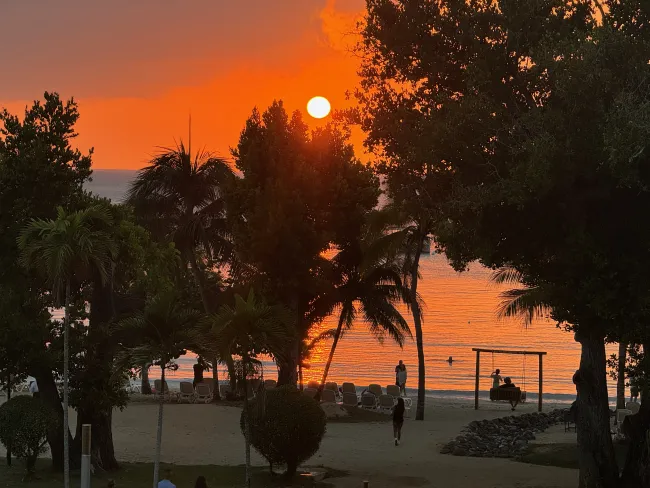
Photo: Ed Yourdon · Club Med in Dominican Republic.jpg · CC BY-SA 2.0.
For travellers who dislike very warm nights, the cooler monthly minima make winter worth considering. Plan city walks early, keep shade and drinking water in the day’s schedule, and take a light layer for a breezy evening or strong indoor air-conditioning. “Cooler” is relative to the local summer, not a promise of weather resembling winter at home.
This is a sensible period to compare a few coastal days with Santo Domingo rather than trying to visit every region. If your dates include Christmas, New Year or another busy holiday, look at accommodation and transport availability before fixing the route. A favourable climate window and an inexpensive room are separate booking questions.
Do not use the Punta Cana figures as a substitute for checking Puerto Plata, Samaná or the highlands. The tourism ministry’s practical guidance notes the difference between coastal trips and mountain stays. Choose clothing and an outdoor plan for your actual overnight base, then look at local forecasts as departure approaches.
April and May: flexibility matters
In the Punta Cana normal, April remains relatively dry while May brings a noticeable increase in rainfall. That comparison makes April an interesting alternative if your dates are flexible, but it is still a historical pattern. Keep a covered option for a city afternoon and avoid building a short trip around a single outdoor activity that cannot move to another day.
For a route combining coast and mountains, leave space between the demanding outings. A wet trail, delayed road journey or cancelled boat does not have to ruin the trip if the next day is not already committed to a distant hotel. Choose flexible booking terms where they solve a real problem rather than paying for flexibility you will never use.
Holiday dates can affect beach crowds, transport and opening arrangements independently of weather. Check the actual dates for the year of your visit. An old page’s Easter or festival calendar should not decide which week you book. The forecast and the social calendar answer different questions, and both belong in a practical plan.
June to November and hurricane-season decisions
The US National Hurricane Center’s climatology defines the Atlantic season as 1 June to 30 November. Activity typically concentrates from mid-August to mid-October, with a climatological peak around 10 September. Storms can also develop outside the official dates. These are basin-wide patterns, not a probability that a particular Dominican holiday will be affected.
If travelling during this period, compare cancellation conditions, the accommodation’s emergency arrangements and your insurance wording before committing. Check what would happen if a flight changed, a road transfer became impossible or a boat excursion was cancelled. “Hurricane cover” is not a sufficient description without the policy’s trigger, exclusions and booking conditions.
Check current information from INDOMET and the Centre of Emergency Operations. Read the issue date and the affected places rather than forwarding an old warning image. Follow instructions from local authorities and accommodation staff. A resort remaining open is not permission to swim, drive through floodwater or continue a closed excursion.
Choose coast, city and highlands separately

Photo: Angel Ramos G · Constanza (15196384558).jpg · CC BY 2.0.
Coastal stays: choose a beach that matches the activity. A shoreline used for watersports is not automatically suitable for a beginner swimmer, and a sheltered-looking bay can still have changing conditions. Ask about the particular swimming area, flags and supervision. Warm air does not establish safe water conditions.
Santo Domingo and other cities: heat, shade and walking distance matter more than a single temperature number. Plan a compact morning walk, a longer lunch or indoor visit, and another outing when conditions are comfortable. Heavy rain can affect roads and access even when the accommodation is dry, so check the return journey rather than judging only the sky above you.
Jarabacoa, Constanza and higher routes: carry layers and shoes appropriate to the planned terrain. Mountain accommodation can feel very different from a beach room. Ask whether the route remains suitable after rain, what equipment is provided and how the operator decides to cancel. Do not treat one coastal weather app as a mountain safety assessment.
Boats, waterfalls and a useful backup day
Put a weather-sensitive activity early enough in the stay that it can move. Ask the operator which changes would produce a refund, a different route or a rescheduled departure. If you have only one available day, understand that a promise to “try again tomorrow” may not help you. Keep the booking terms and contact details accessible.
For waterfalls and river outings, conditions upstream matter as well as the weather at the starting point. A morning without rain does not settle the question after a wet previous day. Respect closures and ask for the operator’s assessment rather than attempting a different entrance independently. Photographing a dramatic river from a safe, permitted viewpoint is a different activity from entering it.
A useful backup is close to your base and realistic in poor conditions: a museum visit if it is open, an unhurried meal, or time at the accommodation. It should not require a long replacement journey along roads affected by the same rain. Leave essential departure travel protected from the most uncertain excursion.
Dominican Republic weather FAQ
What is a good first period to compare for a beach holiday?
December through March is a useful starting window for more comfortable coastal nights. Choose the particular coast and check the forecast; winter does not guarantee a dry or calm day.
When is hurricane season?
The official Atlantic season runs from 1 June to 30 November, with most activity historically concentrated later in summer and early autumn. Conditions outside those dates still need checking.
Does the monthly rainfall table predict my week?
No. It describes 1991–2020 normals at Punta Cana station 78479. It does not forecast your dates, a different coast or the highlands.
Is the temperature column a daytime high?
No. It is the mean daily minimum, useful for comparing cooler and warmer nights. Do not read it as the afternoon temperature.
Can a sunny morning mean a waterfall trip is safe?
Not by itself. Recent and upstream rainfall can affect the river. Follow the operator’s assessment and official closures rather than relying on the sky at your hotel.
Tours, Tickets & Experiences
Dominican Republic Travel Tips & Inspiration